
The US Fed's interest rate decision will be the major factor dictating trends in the domestic equity market this week, with global movements and foreign investor activity also influencing sentiment, according to analysts. Stock markets ended the last week on a subdued note, with benchmark indices Sensex and Nifty closing flat.

Most experts said indices would open higher on Monday and rally might sustain for a few sessions

Stock markets will be driven by RBI's interest rate decision, tariff-related developments, global trends and trading activity of foreign investors in this holiday-shortened week, analysts said.

'Why not aspire for 8 or 9 or even 10 per cent?'

Indian benchmark stock indices, Sensex and Nifty, experienced a significant decline for the third consecutive day, with the Sensex tumbling 1,092 points and Nifty closing below 24,550. This downturn was primarily driven by the India Meteorological Department's forecast of a below-normal southwest monsoon and ongoing geopolitical uncertainties surrounding the US-Iran ceasefire arrangement.

A strong third-quarter (October-December/Q3) performance for 2025-26 (FY26) has helped the stock of India's largest listed pharmaceutical (pharma) company, Sun Pharmaceutical Industries, gain about 7 per cent since the start of February.

When Dhirubhai Ambani entered with his big bang public offer the foundation for the Indian stock market was laid.

Analysts predict continued volatility in Indian equity markets due to domestic macroeconomic data, F&O expiry, global developments including US tariff policies, and geopolitical tensions.

A delegation of Indian startup founders and leaders visited the UK to explore collaborations in artificial intelligence and technology, aiming to strengthen the India-UK innovation corridor.
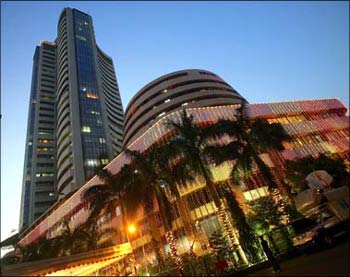
It will be difficult for the Indian equity to outperform overall growth to the extent bullish observers expect.

Indian benchmark equity indices, Sensex and Nifty, snapped a three-day rally, tumbling nearly 1 per cent due to heavy selling in IT stocks, a jump in crude oil prices, foreign fund outflows, and fears of prolonged instability in West Asia.
Benchmark Sensex tumbled 1,236 points or 1.5 per cent while Nifty closed near 25,450 on Thursday following an across-the-board sell-off amid escalating geopolitical tensions between the US and Iran.

The Indian government's decision to ban sugar exports until September 30 has drawn sharp criticism from the sugar industry and farmer leaders, who fear long-term negative impacts despite the stated aim of controlling domestic prices and ensuring availability.

Jane Street could do what they did because of the most fundamental flaw in the Indian stock market: a fragmented, fractured, fissured, fistula-ed liquidity stream, points out Shankar Sharma.

'Of the 20 trading days of January till January 28, FIIs have been selling for 19 trading days'. 'When did FIIs withdraw money with this kind of intensity?' 'It never happened. It's the first. It did not happen even during the 2008-2009 financial crisis when Lehman went under.' 'Even then you did not have like a 19-day selling spree from the FIIs.'

The stocks Radhakishan Damani enters or exits are closely watched by fund managers, says Joydeep Ghosh.

Sun Pharmaceutical Industries' acquisition of US-based Organon & Co. for $11.75 billion, the largest overseas acquisition by an Indian pharma company, has been met with mixed reactions from brokerages, who see strategic entry into women's health and biosimilars but also flag potential integration challenges and debt concerns.

Equity benchmark indices Sensex and Nifty ended higher in highly volatile trade on Tuesday, buoyed by heavy buying in bank and metal stocks, a firm trend in global markets and optimism over India-EU FTA. The 30-share BSE Sensex climbed 319.78 points, or 0.39 per cent, to settle at 81,857.48.

Non-resident Indians (NRIs) haven't gone big on the Indian stock market story despite the post-pandemic boom. While domestic participation through mutual funds (MFs) and dematerialised accounts has soared, NRI participation figures show limited signs of a similar rise.

Dabur India's stock has fallen over 17 per cent since the start of the Iran war, driven by concerns over a weak monsoon, the West Asian crisis, and rising input costs, which are expected to impact the company's revenues and margins, particularly affecting its significant rural sales and international markets.

Indore police have busted a gang involved in investment fraud, arresting five individuals and uncovering links to a WhatsApp account operated from Cambodia.

Overseas investors have poured Rs 43,837 crore ($9.05 billion) into the country's stock markets so far this year, reflecting confidence of foreign funds in the Indian equity markets.

Among the Sensex firms, Bajaj Finance jumped the most by 4.64 per cent. Bajaj Finserv, Kotak Mahindra Bank, Asian Paints, UltraTech Cement, ICICI Bank, NTPC, JSW Steel and Tata Steel were among the major gainers. Infosys, Mahindra & Mahindra, Wipro, Tata Consultancy Services, IndusInd Bank and HCL Technologies were the major laggards.

Despite a sharp increase in import duties on gold and silver to 15 per cent, the precious metals are trading at significant discounts in the domestic market, with gold seeing discounts of up to $200 an ounce and silver up to $6 an ounce.

Domestic Institutional Investors (DIIs) have significantly increased their holdings in Nifty 500 companies, reaching a record 20.9 per cent by the end of March, while Foreign Portfolio Investors (FPIs) reduced their ownership to an all-time low of 17.1 per cent, according to Motilal Oswal Financial Services.

At the outset, decide whether you want to be a trader or an investor, suggest Sarbajeet K Sen and Sanjay Kumar Singh.

'Indian markets may initially react and follow the pattern of US and other global markets post US elections.'

As the government moves to revamp India's securities legislation, unifying three different laws into the Securities Markets Code (SMC), regulatory experts and market insiders have raised concerns on potential funding challenges for the stock market regulator.

The US Fed interest rate decision, domestic macroeconomic data announcements and ongoing quarterly earnings are some of the major factors that will drive the stock markets in a holiday-shortened week, analysts said. Besides, monthly auto sales numbers and the LIC IPO will also remain in focus, they added. Equity markets will remain closed on Tuesday for Id-Ul-Fitr (Ramzan Id). "The market is likely to kick off this week on a sombre note after a sharp fall in the US market then the focus will shift to the outcome of the US FOMC meeting, which is crucial amid record inflation and growth worries.
Indian stock markets on Thursday witnessed a record daily turnover of over Rs 5 lakh crore, even as the benchmark Sensex missed its all-time intra-day high by a whisker.

'Mark Mobius's life was dedicated to investing.'
Wipro and HCL Technologies among its top picks.

S&P Global Ratings warns that Indian oil marketing companies like IOC, BPCL, and HPCL may face reduced profit margins due to rising crude oil prices and government pressure to maintain stable retail prices.

Tata Steel, Tech Mahindra, NTPC, JSW Steel, Power Grid, UltraTech Cement, HCL Technologies and HDFC Bank were among the major gainers. Bharti Airtel, Hindustan Unilever, Axis Bank, Reliance Industries, Kotak Mahindra Bank, ICICI Bank and IndusInd Bank were among the laggards.

The US Fed interest rate decision, inflation data and FIIs are the key factors that are expected to drive stock markets this week, analysts said. Global trends will also be tracked by investors for further cues, they added. "The Indian stock market's future trajectory will be influenced by a blend of global and domestic factors.

In the Indian stock market, investors are interested in the actions of both domestic and foreign institutional investors (FIIs and DIIs). These groups have wealth as well as expertise in research, which makes them powerful participants in the Indian stock market. Their buy and sell positions have a large effect on stock prices and market sentiment due to the large volume.

The diagnostics sector is projected to significantly outperform other healthcare segments like pharmaceuticals and hospitals in Q4FY26, driven by increasing volumes, stable realisations, and a domestic focus that insulates it from geopolitical risks.

The share of foreign investors was lower than domestic institutions across key sectors, including commodities, consumer discretionary, financial services and industrials.

'I cannot imagine that any NSA before Ajit Doval would have given us this kind of time and this kind of engagement. They would have offered slogans, or nothing at all. That, too, tells you something.'
